
In 2025, increasingly powerful wildfires devastated communities from Los Angeles, California, to Spain, Portugal, and across Europe, destroying thousands of homes and claiming countless lives. The need for faster, higher-capacity, and less restricted aerial firefighting equipment — capable of operating around the clock in both urban and rural areas — has never been more urgent.
Recoil Aerospace is giving firefighters worldwide the edge they need with the lightest and fastest helicopter-borne fire suppression solutions on the market. Engineered to aerospace standards, Recoil’s Tsunami Aerial Fire Suppression System (AFSS) enables helicopters to deliver large-capacity drops, day or night, in populated or remote areas alike. The system is already proving its value, with deployments in Austria, Switzerland, Morocco, Canada, Australia, and the U.S. contributing to greater wildfire suppression success.
Tsunami to the Rescue
Available in both internal and external configurations, the Tsunami AFSS meets the speed, volume, safety, and reliability demands of today’s wildfire environment. Built from lightweight aerospace-grade carbon fiber, the system is stronger than steel yet lighter than standard aluminum or fiberglass tanks — enabling aircraft to carry more water. The tanks feature the world’s fastest Vne and are field-repairable, with Recoil’s team able to quickly deploy anywhere in the world to perform repairs.
Both internal and external AFSS tanks are modular and night vision goggle (NVG)-compatible, requiring no structural modifications to the aircraft. This design allows for rapid transfer between platforms. The ability to easily remove the tank prevents the loss of an entire helicopter during maintenance and, in the case of the external version, allows operators to quickly switch to long-line missions when needed.
“The advantages of the Tsunami systems are unmatched,” said Recoil Aerospace president Joseph Rice. “Tsunami AFSS tanks are faster than buckets and even other tank systems, resulting in faster turnaround times and more water dropped on a fire. And since the tanks are attached to the helicopter, there is no snag hazard or limitation on times of day or even areas where the helicopter can fly, which are issues with bucket operations. This means helicopter crews can be far more effective, quickly attacking a fire using direct routes 24 hours a day.”
The Fastest External System
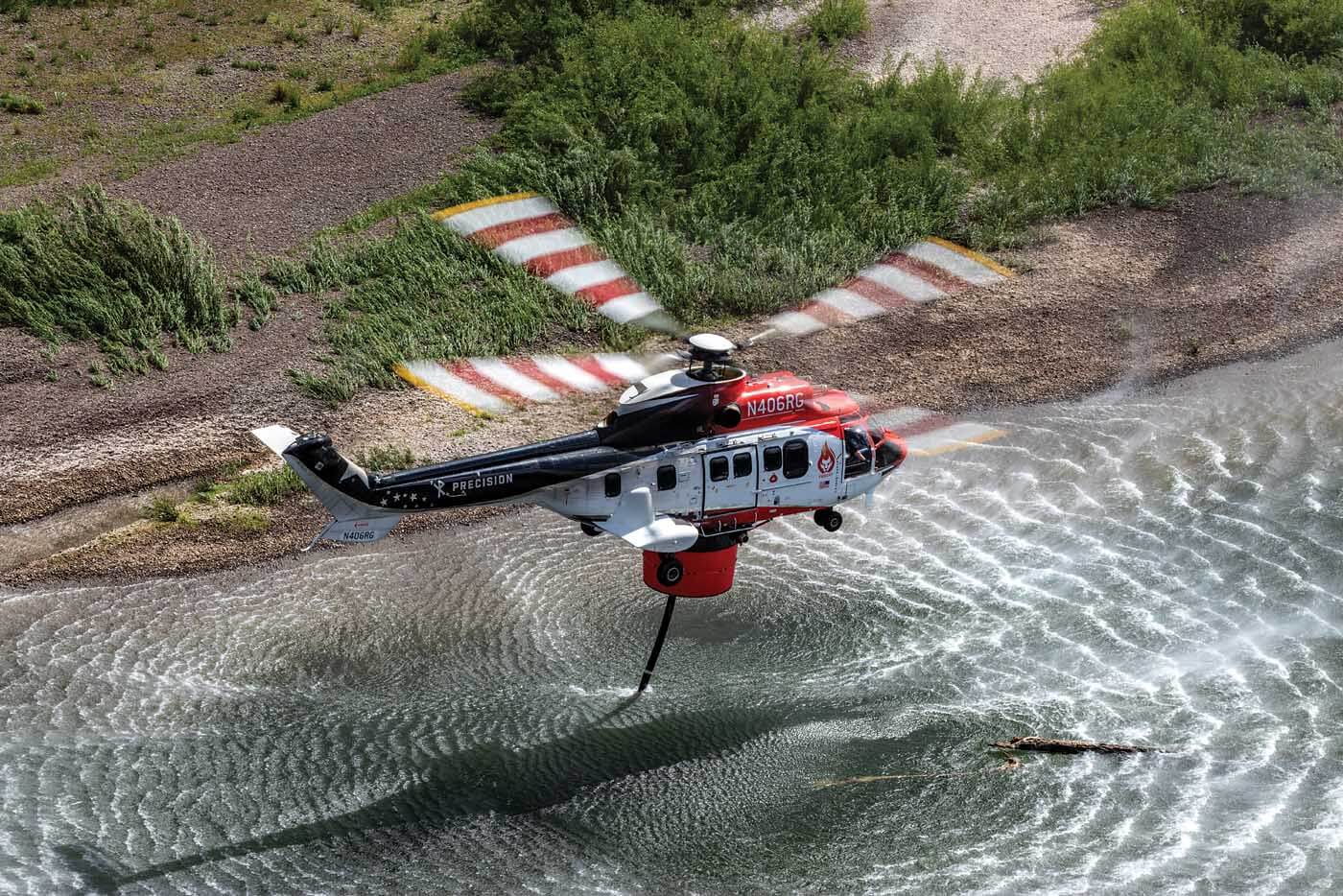
The belly-mounted Tsunami External AFSS is available in three capacities — 650 US-gallons (2,460 liters), 800 US-gal (3,028 L), and 1,000 US-gal (3,785 L). Each offers a Vne of 130 knots (240 kilometers per hour), the fastest of any external AFSS on the market and significantly faster than bucket systems.
All Tsunami external tanks are certified for the Aérospatiale SA330 Puma, Airbus Helicopters AS332 Super Puma, and Sikorsky UH-60 Black Hawk, with additional aircraft expected to be approved soon. The tanks offer variable dispersal options, can fill in as little as 35 seconds, and can empty in just five seconds.
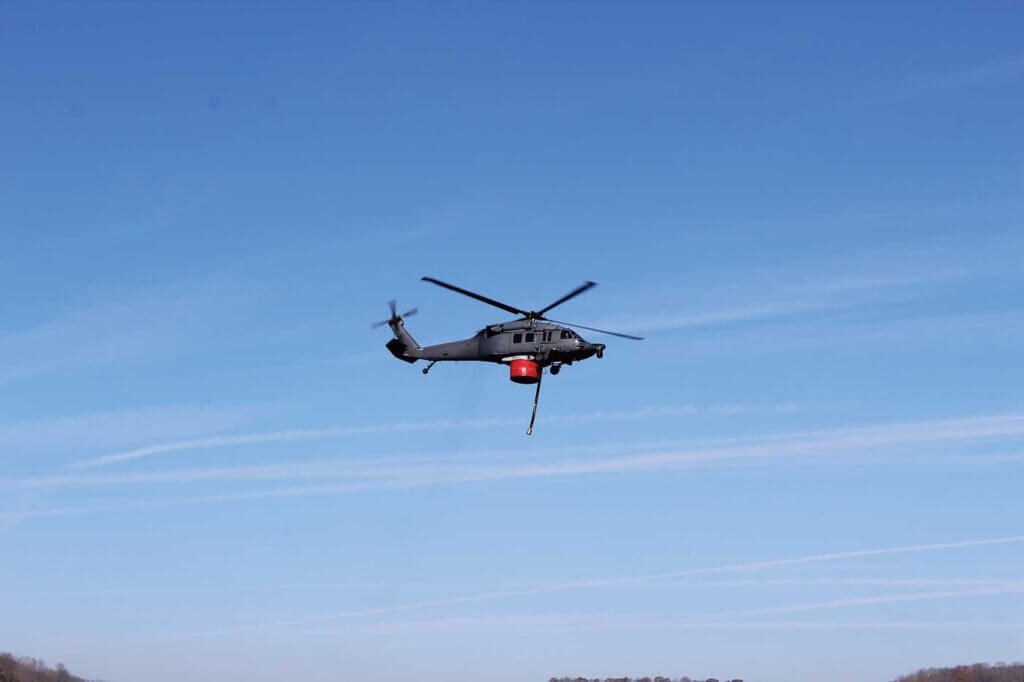
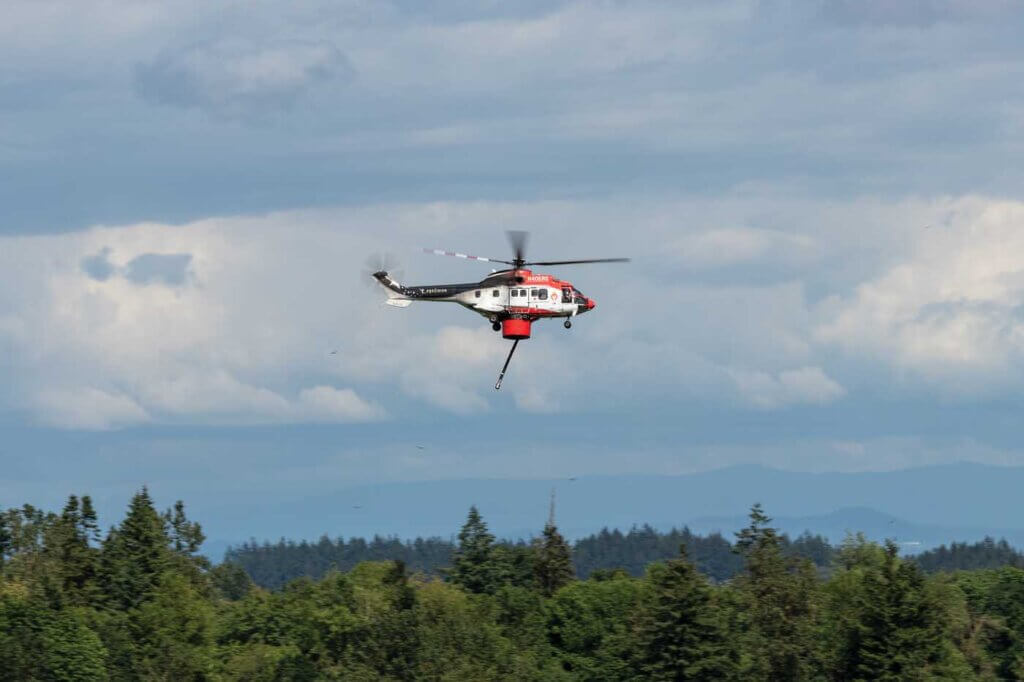
Recoil AFSS-equipped Super Pumas have already flown firefighting missions in Australia and South Korea. Korea’s 119 Rescue Program, for example, is logging high flight hours using the Tsunami T650-E system on its Airbus H225 Super Puma fleet.
Unlike other external systems, the Tsunami External AFSS requires no landing gear or structural modifications, reducing both acquisition and operating costs. The tank inflates downward when filled and retracts rapidly when empty, restoring full ground clearance for landing.
The pneumatically operated system also includes an integrated foam tank, foam injection, pulse lights, NVG-compatible IR lighting, an external hailing speaker, and left- or right-side snorkel operation.
Internal Advantage
Recoil’s AFSS design has quickly gained attention from U.S. fire and utility operators, including launch customer Central Copters of Montana.
“This is a game-changer for us, a key flex in our operations,” said Will Jacobs, chief pilot of Central Copters. “The Recoil Tsunami Internal AFSS Tank allows immediate access to the UH-60 cargo hook for additional mission assignments without having to remove the tank, thanks to its light weight.”
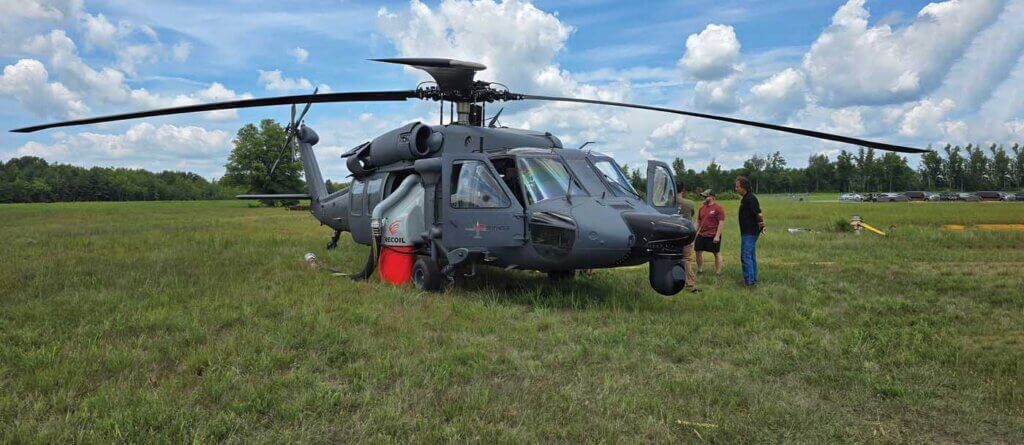
The Tsunami Internal AFSS is a 790-US-gal (2,900-L) tank certified for the UH-60. It can fill in as little as 25 seconds from an open water source, fire hydrant, or fire truck. The system includes an integrated foam tank, foam injection, an external visual sight gauge, a hand-controlled quantity indicator for the flight crew, and left- or right-side snorkel operation. The internal AFSS also offers an even higher Vne of 140 kts (260 km/h).
By keeping the belly clear for cargo hook operations, the internal design preserves the aircraft’s multi-mission capability — enabling crews to quickly transition between essential long-line work and aerial firefighting drops.
Worldwide Certification and Support
The Tsunami External AFSS is certified in the U.S., Canada, Morocco, Australia, Mexico, and Brazil, with additional certifications expected from Europe, Colombia, Japan, Singapore, Indonesia, New Zealand, and Korea by the end of 2025. The Internal AFSS is already Federal Aviation Administration (FAA)-approved, with international approvals also anticipated by the end of 2025.
Recoil Aerospace stands behind its systems with exceptional customer support. Customer calls are answered by a person and the team springs into action to help solve any issue, Rice explained.
Learn more by visiting Recoil Aerospace at European Rotors 2025 in Cologne, Germany, from Nov. 18 to 20 at Booth 1604.
This sponsored article was created by Insight magazine, the sponsored content division of MHM Publishing.