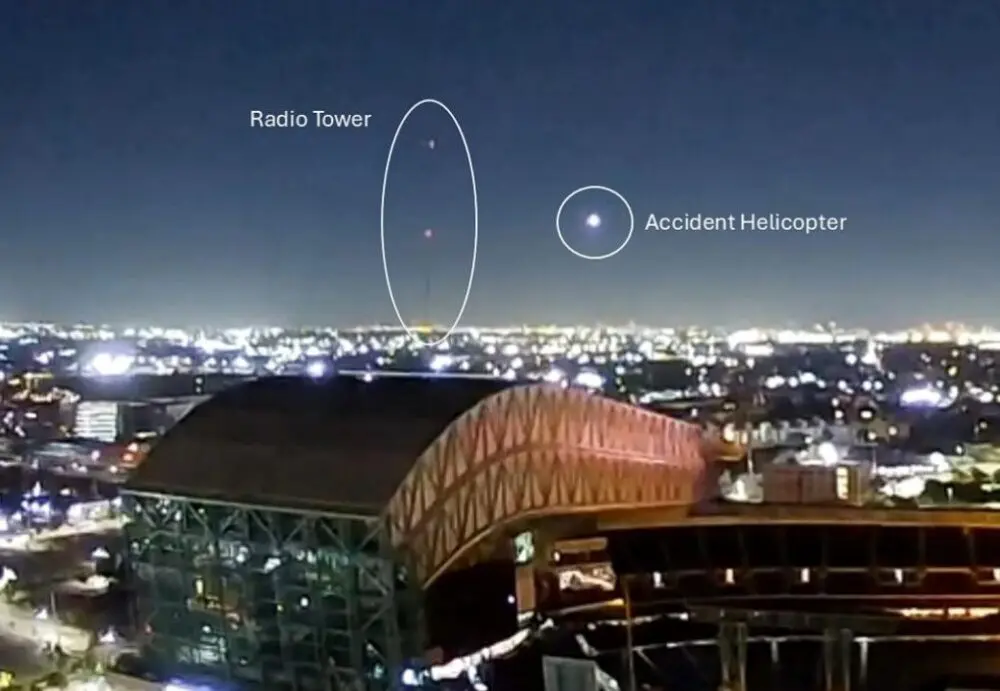
In its final report published Sept. 23, 2026, the National Transportation Safety Board (NTSB) determined the probable cause of the fatal 2024 Robinson R44 II tour helicopter crash in Houston was the pilot’s failure to maintain clearance from a lighted radio tower during a night flight.
The air traffic controller’s failure to issue a safety alert notifying the pilot of the flight’s unsafe proximity to the tower was also cited in the report as a contributing factor.
On Oct. 20, 2024, the Robinson R44 II (N881KE), owned by National Helicopter Solutions LLC, was conducting a night sightseeing tour under Part 91 when it struck the 1,003-foot tower around 7:51 p.m. The pilot, 42, and three passengers were killed.
The helicopter departed Ellington Airport, southeast of Houston, at about 7:42 p.m. and flew toward downtown. The pilot contacted Houston Hobby Airport control tower asking for the ‘downtown loop,” an unpublished route local helicopters fly over downtown. The controller approved the request.
Several minutes later, the controller advised the pilot of another company tour helicopter in the vicinity. The pilot said she saw the other helicopter on her ADS-B but had not spotted it visually. The controller told her to maintain visual separation. Her transmission ended abruptly while she was reading back that instruction.
The helicopter hit the tower about 100 feet below its top, exploded, and fell to the ground. The tower then collapsed onto the wreckage, and a fire destroyed the helicopter. Flight data showed the helicopter flew a straight path toward the tower, below the tower’s height, until impact. Skies were clear with 10 miles of visibility.
The tower was marked as an obstruction on the Houston VFR sectional and terminal area charts and on the controller’s radar display. A radar replay covering the final 30 seconds or so before the collision showed the tower in line with the helicopter’s flight path.
Surveillance video showed the tower’s top and middle beacons flashing red as the helicopter approached. The lower beacon was not visible in any imagery.
The FAA requires controllers to give first priority to separating aircraft and issuing safety alerts. It also requires an alert when a controller is aware that an aircraft is in unsafe proximity to an obstruction. VFR pilots remain responsible for avoiding obstructions, but the alert requirement still applied. No alert was issued.
Traffic at the time was light, the controller’s workload was routine, and there were no unusual distractions.
The pilot held commercial pilot and flight instructor certificates and had 1,075 total flight hours. The company hired her in August 2024, and she began flying the company helicopter on Sept. 23, 2024. Her husband told investigators she had worked about nine consecutive days before the accident. Toxicology tests found no drugs or alcohol.
Examination of the wreckage found no mechanical malfunctions or failures that would have prevented normal operation.