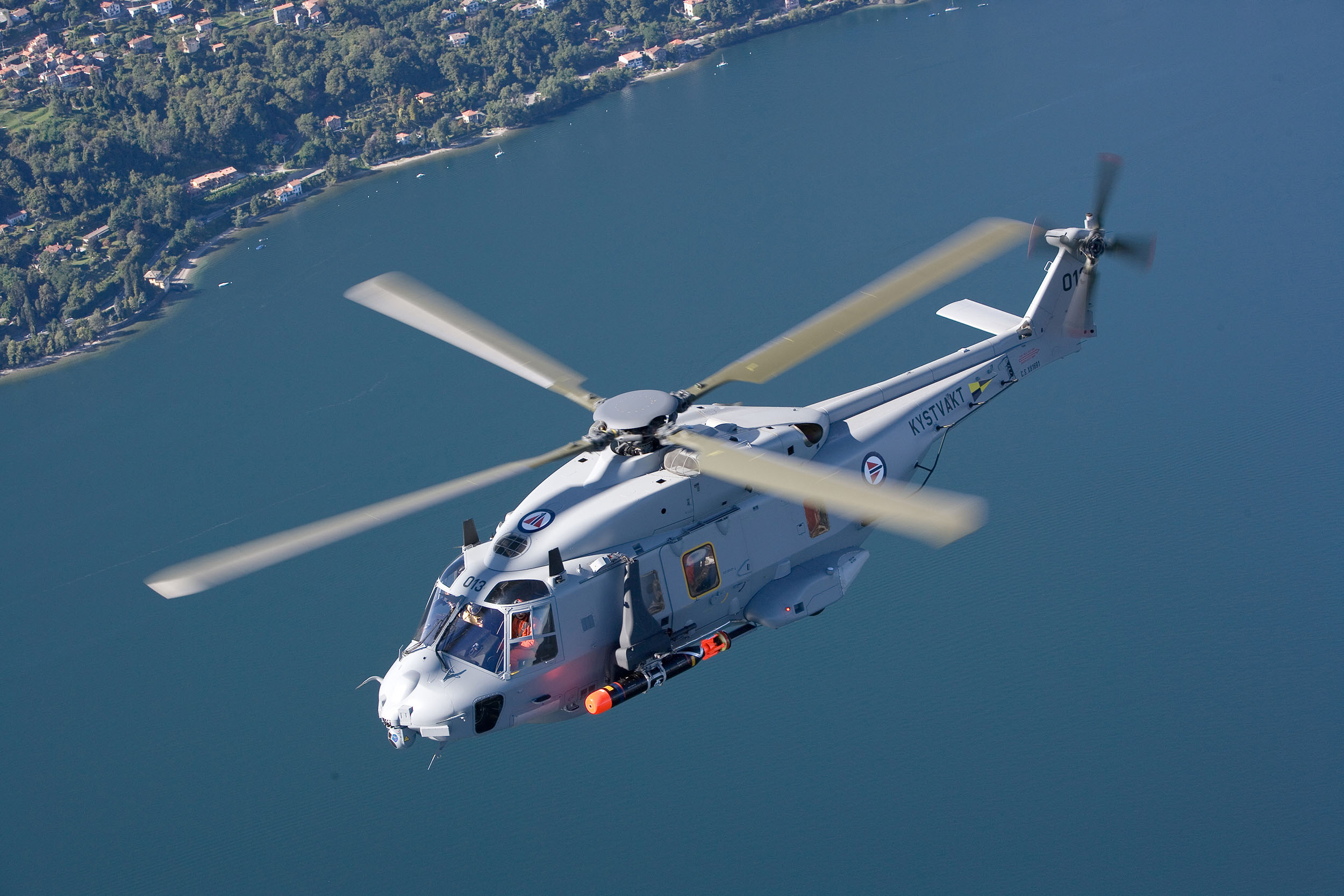
The Norwegian government has agreed a settlement with NHIndustries that will see it send back its fleet of 14 NH90s and receive €375 million in return.
The country ended its NH90 contract with NHIndustries (a consortium comprised of Airbus Helicopters, Leonardo and Fokker) in 2022, citing the manufacturer’s inability to find replacement components for critical systems on the helicopter.
At the time, Norway was requesting a full refund for the program — which cost an estimated five billion kroner (about €425 million).
The country’s acquisition of the NH90 began in 2001, with 14 helicopters for the Coast Guard and anti-submarine warfare duties — and an expectation that all would be in service by late 2008.
Prior to the termination, only eight had been delivered in full operational configuration. The fleet was expected to fly 3,900 flight hours per year, but had only been averaging around 700 hours shortly before Norway cancelled the program.
In 2023, the country announced it was ordering six Sikorsky MH-60R Seahawks to take on the maritime mission — but these are yet to arrive.
The settlement with NHIndustries will see the manufacturer take back the aircraft and all associated spare parts, tools and mission equipment. They will be “reintegrated” within the NH90 program, and made available to other NH90 users.
The cancellation of the Norway program follows Australia’s retirement of its fleet of 46 NH90s — known in the country as the MRH90 Tapian — in 2023.
Speaking to media during a briefing at Airbus Helicopters’ facility in Marignane, France, last month, Axel Aloccio, head of the NH program, said the company has “recovered” 4,000 parts from the Australian NH90 program. A quarter of those have already been revalidated and reintroduced into the manufacturer’s inventory.
“We had to go through a revalidation loop with our suppliers, to make sure that the parts are airworthy and are in a proper airworthy condition,” said Aloccio. “This has taken a bit of time, and the process is still ongoing.”
The company has worked hard to increase maintenance, repair and overhaul (MRO) capacity over recent years, said Aloccio.
“The situation is not perfect yet — we still have a few items on which we are still facing some difficulties, but we are on the right track, and we will get there,” he said. “I am really confident when I can say that most of the supply chain issues are behind us.”
More than 500 NH90s have been delivered to 18 customers in 14 countries, with the global fleet quickly approaching 500,000 flight hours. It is primarily available in two versions: NATO frigate helicopter (NFH), optimized for maritime operations; and tactical transport helicopter (TTH), oriented towards land applications.
The biggest NH90 fleets are in operation with Germany, Italy, France, and Spain.
Last year, NHIndustries and the NATO Helicopter Management Agency (NAHEMA) signed a contract to launch the NH90 Block 1 upgrade. This €600 million program includes an upgrade of the aircraft’s communication suite, as well as options including the integration of the latest generation electro-optical systems, a new dipping sonar, and integration of the MK 54 torpedo and the Marte ER anti-ship missile.
Block 1 will be retrofitted on about 200 NH90s belonging to Italy, Belgium, Germany and the Netherlands, with a targeted timeframe from 2028 to 2035.
“It shows the commitment — the strategic commitment — of the different armed forces, but also the financial commitment of those countries [operating] the NH90, into making this platform even more capable than it already is,” said Aloccio.
“It’s a very, very strong sign, coupled to the fact that a lot of customers are placing repeat orders like Germany, like Spain, like France — and hopefully, very soon, like the Netherlands.”
Earlier this year, Airbus and Leonardo announced they would be carrying out an architecture study to determine the next step in the NH90’s evolution — known as the Block 2 upgrade.
Aloccio said this would focus on the aircraft’s avionics, in order to make them “more modular” — aligned with a modular open systems approach (MOSA).
“Block 2 will also be about simplifying the maintenance plan and the support of the NH90 in order to make it a bit more friendly for technicians,” he said.
Qualification of Block 2 is pencilled in for sometime between 2035 and 2040.
In July, Germany qualified the NH90’s NFH “Sea Tiger” version — and the first of 31 Sea Tigers is due to be delivered to the German Navy in December. They will be used primarily for antisubmarine warfare.
Sweden continues to decide what it intends to do with its fleet of 18 NH90s, said Aloccio. Over the last two years, they have increased their flight hours by 60 percent, he added.
“This process of whether to keep the NH90s or not was driven by a situation that was prior to 2022,” he said. “Sweden was in the middle of retrofits and they were struggling a lot with their NH90 fleet because they didn’t have enough numbers.”
With that retrofit now complete, he said the country’s NH90s are now “flying a lot.”
“The situation has completely changed in the last two years, thanks to the end of the retrofit and the huge increase in flight hours. What will this mean in the end for them, in terms of what decision will they take? It’s their decision.”