
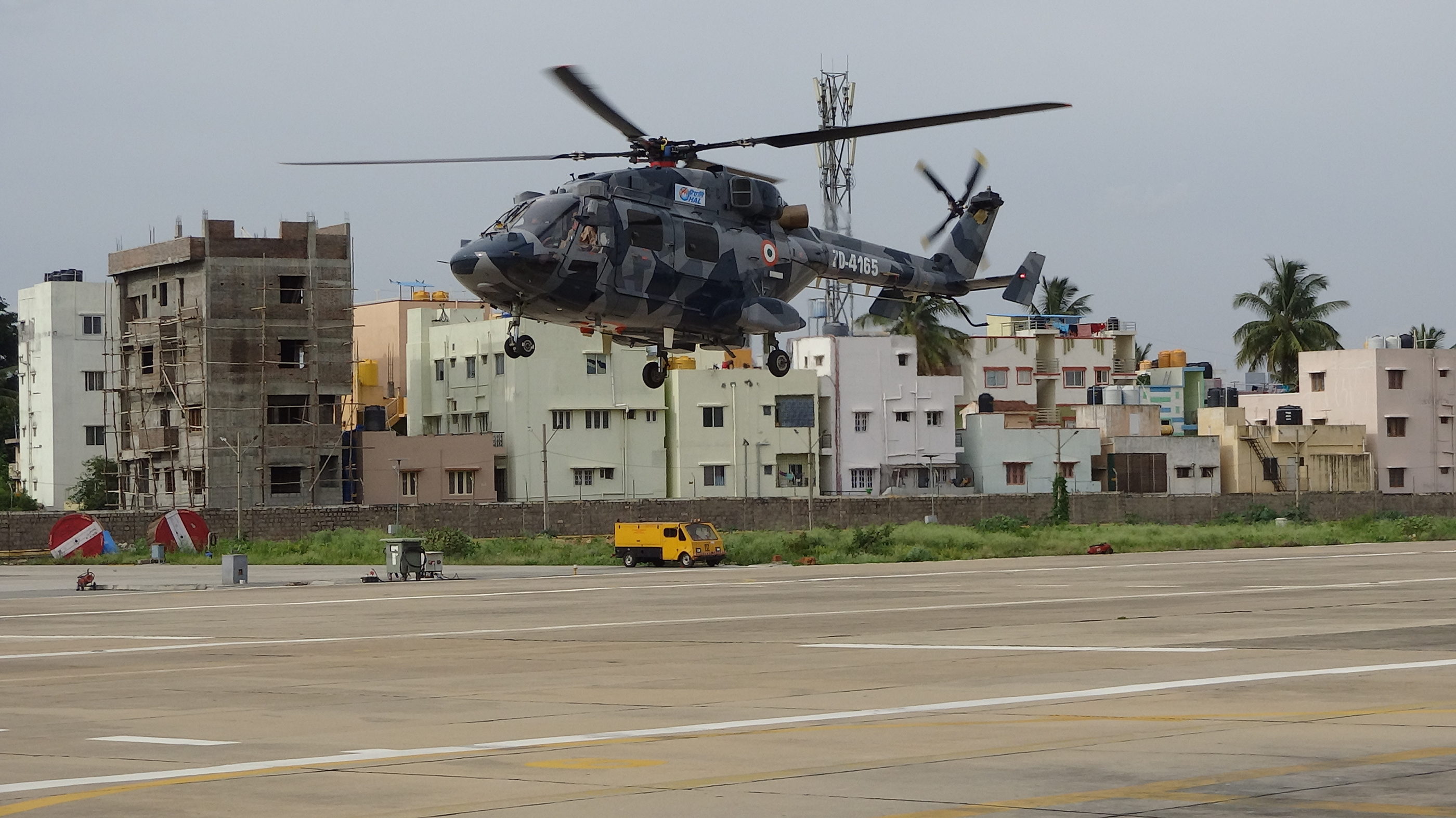
After one of the longest-ever groundings in the history of the Indian Navy, Advanced Light Helicopters (ALH) are set to resume flights in a phased manner with restrictions.
The type had been grounded since CG859 hit the runway shoulder at Porbandar in western India, killing two coast guard pilots and an aircrewman diver. Manufacturer Hindustan Aeronautics Limited (HAL) had recommended grounding the entire ALH fleet after preliminary analysis of the flight data recorder revealed the helicopter did not respond to pilot inputs seconds before impact.
The Board of Inquiry (BoI) and Defect Investigation (DI) committee identified a catastrophic failure at the non-rotating swash plate (NRSP). This critical component in the upper control circuit of the ALH transmits pilot control inputs to the four-bladed hingeless main rotor.
Previous failures in the control circuit that caused major accidents were related to booster rods in the “collective” circuit. That was addressed by replacing the original control rods with stainless steel rods of a new design. CG859 was the first recorded case of catastrophic failure at the NRSP of an ALH that caused it to lose cyclic control. There is no known method or flying technique to recover from such a failure. As such, airworthiness certification requires that design, metallurgy and manufacturing process of such components ensure a fatigue life far in excess of the envisaged life of the helicopter.
During the year-long grounding, HAL undertook a fleetwide inspection of the proprietary Integrated Dynamic System (IDS) that houses most of the critical components in the ALH dynamic system and upper controls. Multiple cases of fatigue failure of NRSP were observed, primarily on the batch of brand-new wheel variant ALH Mark3 Maritime Role operated by the Navy and Coast Guard, while similar failure was not noticed in any other variant of the ALH, as per a former HAL official who headed the rotary design centre at Bengaluru.
The defective batch of NRSPs have since been withdrawn from all users, to be replaced by new Cat. A NRSPs. While it has not been publicly acknowledged by HAL, the finding of the DI committee on similar lines likely formed the basis for lifting the grounding of the skid-variant ALH. The Army and Indian Air Force — which operate the skid variant ALH — resumed flying in May last year, while the Navy and Coast Guard airframes continued to be grounded.
The most salient difference between Navy/Coast Guard ALH and the Army/Air Force versions is the landing gear. The former operate the wheeled landing gear version of the ALH, whereas others predominantly use the skid variant. The 5.75-ton enhanced maximum all-up weight (MAUW) ALH Mk3MR that the Navy and Coast Guard inducted between 2021 and ’23 have non-retractable, fixed-wheel landing gear.
HAL has been the single-point repository of all developmental and usage data of the wheeled variant ALH since 2000. However, it has not officially revealed if the reduction in fatigue life of NRSPs by an order of magnitude could have been foreseen or predicted. This fuelled speculations around “usage pattern” of Navy/Coast Guard ALHs from HAL designers, while independent analysts opined the failure could be related to manufacturing process of a particular “batch.”
To further investigate the first vector, fully instrumented flight trials were undertaken on wheeled variant ALH jointly by HAL and the Navy to map loads on the dynamic system from the Navy and Coast Guard’s usage pattern and operating environment. This included ashore and afloat trials, including multiple deck landings in heavy seas.
Informed sources indicate flight test results did not unearth any significant unmapped loads, raising the question of why NRSPs that typically have a life running into tens of thousands of hours failed at a few hundred hours. HAL officials have declined to comment.
The resumption in flying is likely to follow a stepladder approach using brand new NRSPs with significant reduction in life, while alternative pathways to improve fatigue life of the component are explored. This may involve redesign, improved metallurgy & fabrication process (shot peening), the details of which are yet to be made public.