



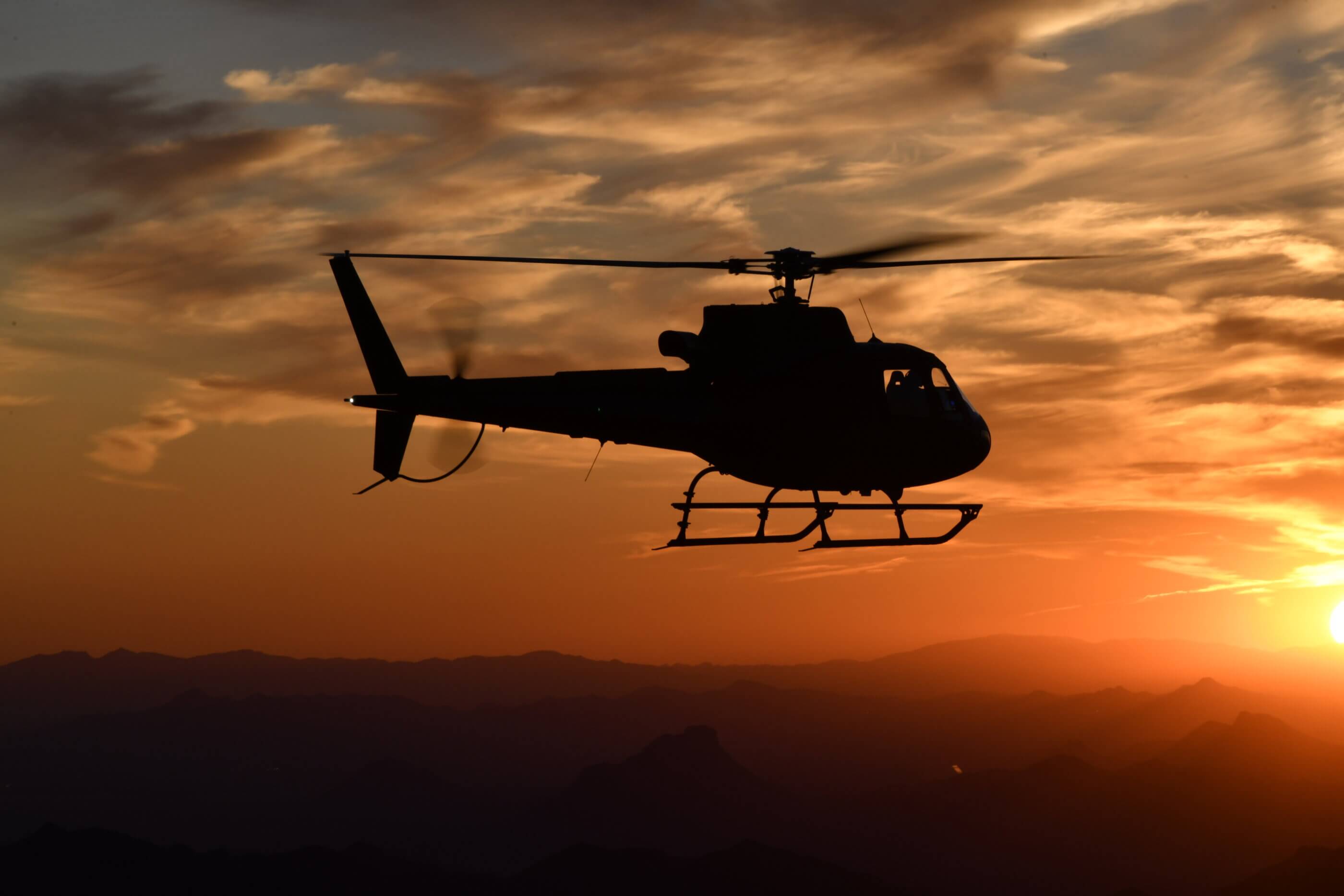
In the late afternoon of April 25, 2021, an Airbus H125 operated by Great Slave Helicopters took off under visual flight rules (VFR) from a remote camp on Russell Island, a far-north section of Nunavut, Canada.
The aircraft carried pilot Steven Page, engineer Benton Davie, and biologist Markus Dyck, toward Resolute Bay Airport, about 87 nautical miles to the northeast, after conducting polar bear research, the Transportation Safety Board (TSB) of Canada later found.
They never arrived. At around 4:33 p.m. local time, the aircraft crashed on snow-covered terrain on Griffith Island, about 12 nautical miles southwest of the airport. The impact sequence destroyed the aircraft’s emergency locator transmitter, and there were no survivors.
A TSB investigation found snow squalls likely created flat light and whiteout conditions above the tree line, leading to loss of visual reference to the ground—an inadvertent flight into instrument meteorological conditions (IIMC).
The aircraft descended unintentionally, while the pilot was likely trying to visually maneuver.
Sadly, this is startlingly common for winter flying in Canada, when the weather often changes quickly. Severe and dangerous conditions can appear out of the blue, catching pilots off-guard.
After decades of flight occurrences and dozens of deaths, there’s a renewed push for both regulatory and voluntary change.
“It is a situation we are seeing across the country,” said Yoan Marier, TSB chair.
“Up north in the winter, there are very few references that can help pilots situate themselves. Add in blizzard conditions, and that’s a very bad mix.”
HELICOPTER VS. FIXED-WING
In Canada, the TSB attributed 144 deaths to a loss of visual reference between the years 2000 and 2021. Although not every crash is fatal, rotorcraft operators were twice as likely as fixed-wing operators (3.38 percent vs. 1.55 percent) to crash due to IIMC during the study period.
The ratio was even higher between 2021 and 2024, when the TSB attributed 8.85 percent of helicopter crashes to IIMC vs. two percent of fixed-wing accidents.
“What comes out in almost all our investigations is that pilots were often not prepared to face these conditions,” said Marier. “This is especially true for helicopters, where a lot of operations are day-VFR-only.”
Rotorcraft operations often stay grounded when bad weather is forecast; as a result, many companies don’t train for instrument flight rules (IFR) conditions. When bad weather hits, the TSB believes, many pilots are ill-prepared.
“They don’t have the training, and they don’t have the equipment,” said Marier. “It puts them in a very bad situation.”
In Canada, the TSB investigates aviation accidents and makes recommendations, but has no regulatory authority. Binding regulations are the purview of Transport Canada, which has powers similar to the U.S. Federal Aviation Administration or the European Union Aviation Safety Agency.
After drawing attention to the dangers of winter IIMC for more than 30 years, the TSB has launched a renewed push for regulatory change. The agency wants Transport Canada to require helicopter pilots to complete mandatory initial and recurrent training for IIMC.
The agency also recommends mandatory flight equipment to improve situational awareness.
“We’re not pointing out to a specific tool or specific technology,” said Marier, listing radar altimeters and synthetic vision devices as examples.
“If it becomes part of the minimum safety requirements … that would help fix the safety deficiency that we have identified,” he said.
“Understanding that regular regulatory change can take time, we do encourage operators to adopt these solutions voluntarily.”
Other countries have similar problems with winter IIMC. Marier pointed to Sweden and Norway, which have similar winter conditions to Canada. “But this can happen in any climate,” he said, noting that other areas of the world, like the Middle East, are seeing issues with dust and smog.
“Pilots are faced with these issues all over the world, and whatever can be done to help them in avoiding and recovering from inadvertent IMC, that will certainly save lives.”
TAKING THE INITIATIVE
Beyond a shift in regulations, the TSB is asking pilots to be more cautious when planning around weather forecasts. There’s a keen understanding here that pressure to fly for economic reasons or operational goals can be dangerous, habit-forming, and potentially fatal.
“Pilots have a natural tendency to want to get the job done,” Marier said. “Cancelling because of weather, when you have a community or a group of workers waiting for you, is always difficult”
“Previous success doing something risky will support future behaviors,” he added. “So additional work is needed to raise awareness about these pressures and biases that can occur in flight.”
After the fatal Griffith Island crash, Great Slave Helicopters voluntarily implemented several safety actions, according to the TSB. These included a company-wide safety stand-down before returning to work, amendments to SOPs, increased recurrent training for pilots, and several measures to manage safety, including a safety management system (SMS).
The hope is other operators will also proactively address the problem while Transport Canada considers the parameters of a regulatory response.
“Safety is a shared responsibility,” said Marier. “Everyone has a key part to play in the equation, and the regulations only provide the minimum level of safety.
“There’s nothing preventing operators from going above this minimum and implementing proactively—additional training, better technology, voluntary safety management systems—that can help mitigate the risks in their operation. And we know that a lot of operators are doing it; we have to acknowledge that. We are seeing a lot of positive movement in the field.”

I have been advocating for change for decades. Identifying the problem is the first step to finding a solution. Defining the conditions that lead to CFIT and spacial disorientations is the second. In this article I see terms like “IMC” and “IFR conditions” when these do not help us educate pilots. The “M” and the “R” are distracting us and do not lead us to the training that pilots need to identify conditions that can lead to CFIT and prepare them to survive.