



Few in the civil aerospace industry (or outside it) would question the need for robust safety regulation, or the vital role that is played by a strong and independent safety regulator.
However, it’s also worthwhile thinking about what other means are available to help operators remain both safe and successful — the aim of everyone in our industry. One of the primary methods is through safety promotion, the often overlooked fourth pillar of safety management as outlined in ICAO Annex 19.
The sharing of lessons learned and best practices can be particularly powerful for those parts of the industry dominated by a large number of small operators, as they may not have achieved a “critical mass” of experience within their own organisations.
More specific to rotorcraft, safety promotion is also well worth considering for activities where issues with the design represent a very small sub-set of the events recorded in service or the operational risks people face.
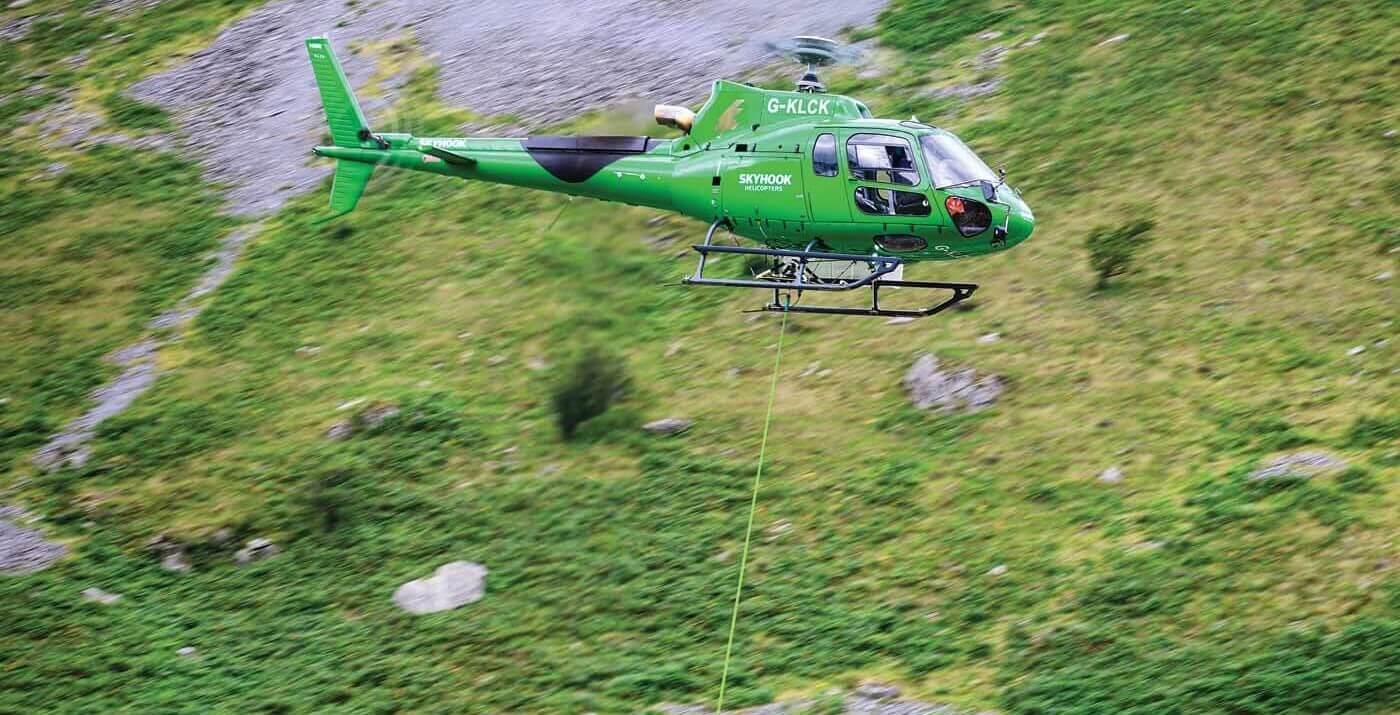
Rotorcraft sling load operations (i.e. loads — including human — which are carried on a hook under the helicopter, on a line of a fixed length) are a clear example of this.
Not only is the European market for such operations dominated by a large number of small operators, but also the design integration in the helicopter is largely optimised.
This means that only small incremental gains in safety can be achieved by further design changes. This is borne out by the available data of in-service events, which are dominated by operational causes rather than problems that can be attributed to the design.
The European Union Aviation Safety Agency (EASA) created the European Safety Promotion Network Rotorcraft (ESPN-R) in 2017 with a desire to share best practice within rotary-wing operations.
It was based on the experience acquired by its predecessor, the European Helicopter Safety Team (EHEST), created in 2007. ESPN-R brings together experienced professionals on an informal and voluntary basis. There are various sub-groups within ESPN-R, one of which is for sling load operations.
For the past six years, I have had the privilege to be the EASA representative in the ESPN-R Sling Load Operations Safety Promotion Task Force, led by Airbus Helicopters.
As an engineer of nearly 30 years’ experience, this has allowed me to see much more closely how certified designs are operated in-service — and the risks involved in this type of activity.
It has also has brought me in contact with a great range of experienced professionals, including helicopter OEMs (such as Airbus Helicopters Deutschland), equipment manufacturers (Airwork & Heliseilerei, Switzerland), training organisations (D-HOPF, Bavaria, which was previously in German Federal Police) and other airworthiness regulators (specifically FOCA, the Swiss national regulator, reflecting the over-representation of sling loads operators in the Alpine regions).
Despite the fact that the “E” in ESPN-R stands for European, another fantastic step within the last couple of years has been the expansion of our group “across the pond,” with colleagues from both Bell Helicopters and Onboard Systems welcomed — bringing different perspectives and a further wealth of experience.
Our basic modus operandi is to begin with databases of reported events from recent years. As with any database, the quality and quantity of what can be extracted is only to the level of the input, but we have found a real wealth of data on which to base our work.
We then sub-divide the events into similar root causes — what we call “clusters” — where we perceive a positive benefit could be made through a transfer of knowledge. It does not take long to see these clusters emerge from the data, and each is discussed in-turn during our monthly meetings.
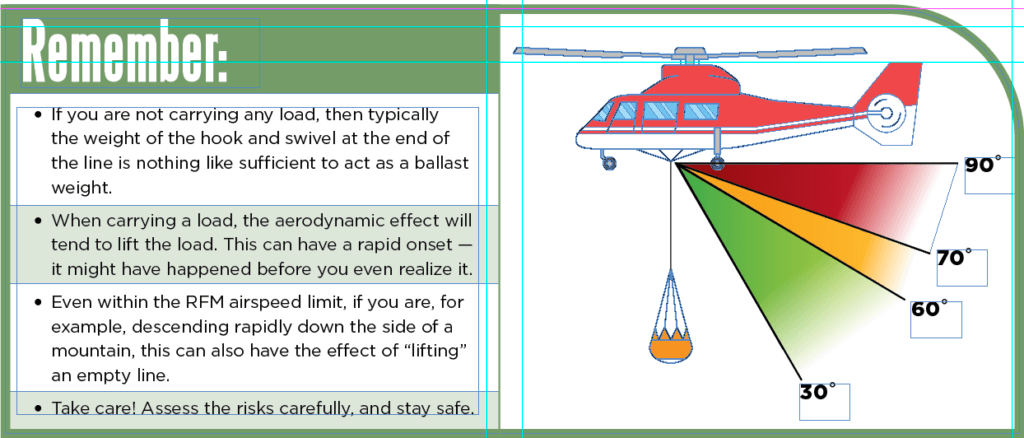
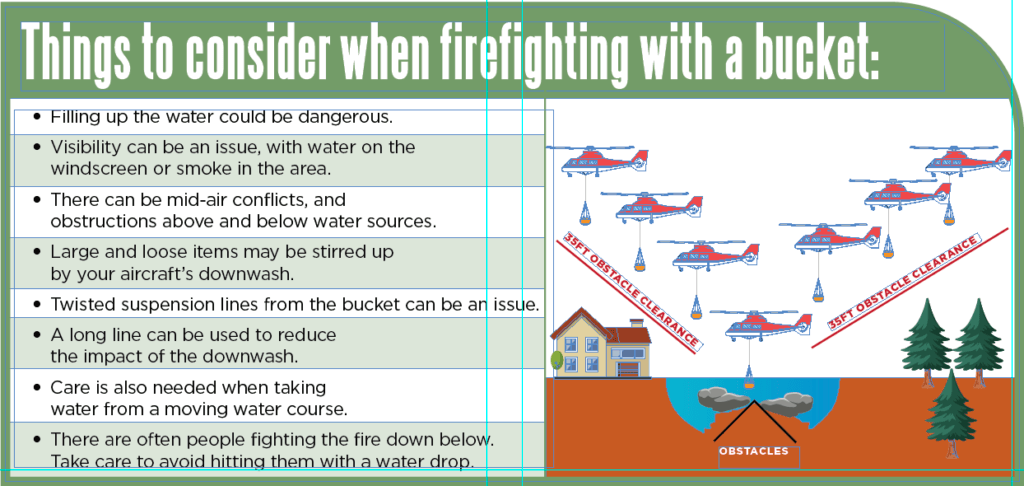
Examples of the clusters we have considered include the load striking the tail rotor; mis-rigging of the hook release cable, leading to inadvertent load release; spinning of the carried load — a particular problem when the “load” is a person; snagging of the load on ground; and all operational risks pertaining to firefighting operations.
Each cluster is discussed within the group and the pertinent advice is then written and promoted. Our main communication outlet is our LinkedIn page.
However, we have begun to increase our outreach by going on tour, presenting our group and outcomes, and delivering demonstrations in the Rotorcraft Safety Zone of European Rotors in Madrid (2023) and Amsterdam (2024), and this year’s edition in Cologne.
These presentations have been well supported by Airbus Helicopters, who very-kindly constructed and transported a full mock-up of a sling load installation with all the associated systems and equipment. This has enhanced our presentations, and allows people to come and view (and play with) the real systems and equipment.
We’re expanding our outreach in other forums. We also try to meet as a group face-to-face at least once per year. This is not easy, given our widespread geographical range and that we’re doing this on top of our “day jobs” — but the value of these in-person meetings cannot be underestimated.
I have intentionally saved the best for last — and that is the working dynamic of our group. As mentioned at the beginning of this article, all actors in our industry, at all levels, have a common goal to be safe and successful.
However, the simple realities of commerce and economics — in any industry — mean that relationships can become adversarial and conflicting from time to time. This is simply never the case with the colleagues (across industry and continents) that I have the pleasure to share this task with.
We leave our day jobs at the door during our collaborations — including representatives from organizations that are usually in direct competition with each other. And while safety promotion is a very serious business, we have brought our highly diverse backgrounds together in ways that are collaborative, professional, informal and fun.
And if even a fraction of our advice is useful to even a fraction of those who receive it (and we understand that we are way beyond this), then our time will have been very well spent.
Does any of this sound interesting and/or relevant to you? Our doors are always open to new members, new experience or new initiatives. You can reach us through our LinkedIn page.