




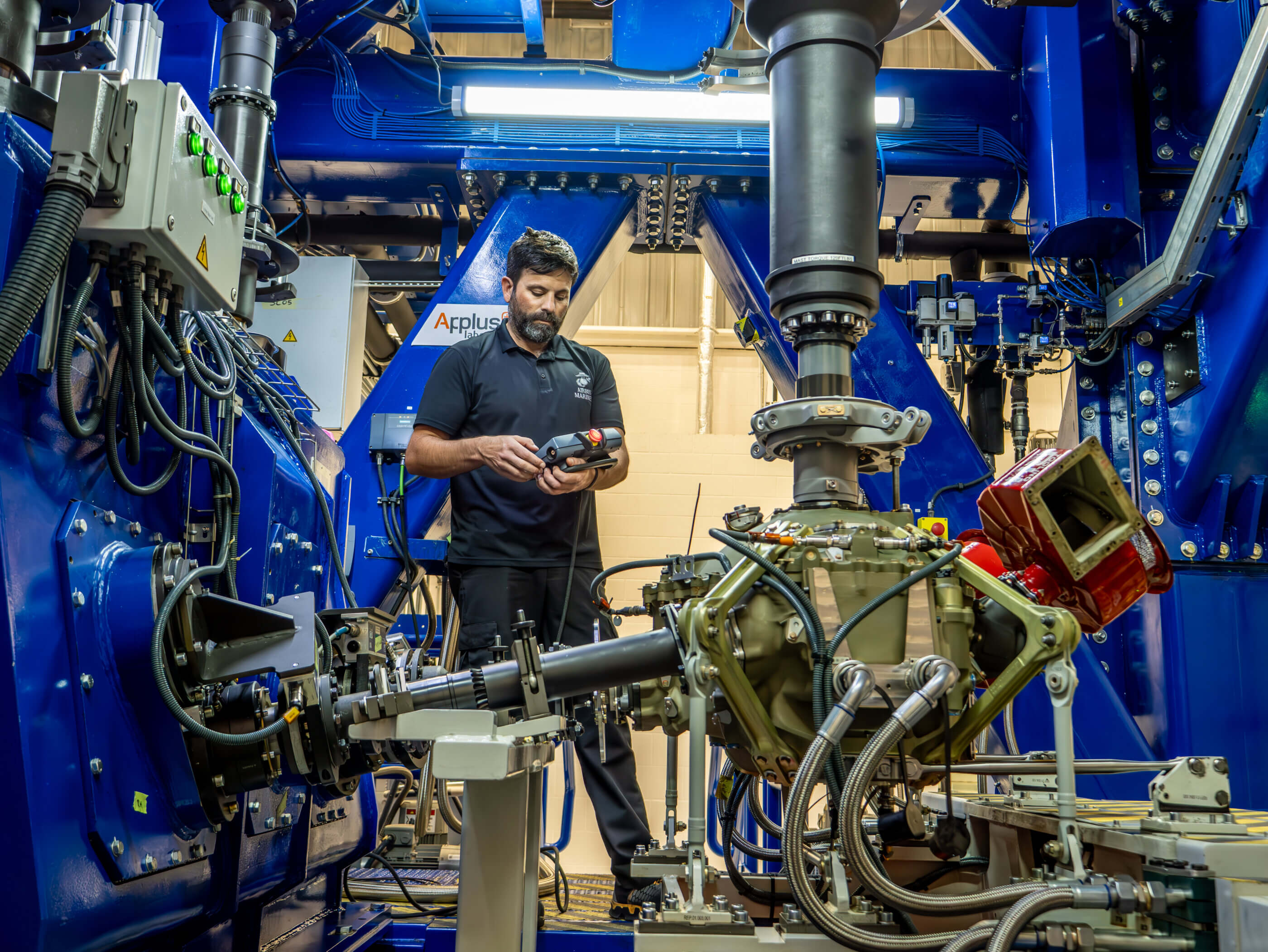
At ground level of a new state-of-the-art test bench at Airbus Helicopters Inc. headquarters in Grand Prairie, Texas, a bearded technician punches buttons on a hand-held electronic device.
A massive, tubular shaft extends down from the bench’s towering upper platform, connecting to a disc-shaped base, as another technician methodically turns wrenches on metal fasteners.
“What we’re doing is making sure every dynamic component we assemble, overhaul, and repair here in the shop is 100 percent safe,” said Niko Szodruch, head of customer support and services for North America, speaking with Vertical from the shop floor.


Airbus Grand Prairie’s new, state-of-the-art test bench services H135, H145, H160 and AS365 family components. Brent Hallman Photos
“[We also ensure] the highest levels of quality,” he added. “We put it through a full load cycle test here so we can assure there are no issues with leakage, no issues with the gears, how they connect with each other.”
This state-of-the-art, next-generation tool enables the Grand Prairie facility to service aircraft from the H135, H145, H160 and AS365 helicopter families, at a vastly-improved pace.
“The biggest advantage of this test bench is that we can test about four times the dynamic components compared to the previous ones, just by using different technology,” said Szodruch. “It’s kind of plug and play, like on your computer.”

There are several older test benches here, at the U.S. subsidiary of Airbus’s main rotorcraft operation in Marignane, France. But they are relics of their time — less efficient, less versatile, and more time-intensive to coordinate.
“Previously, we spent a lot of time for the installation and the uninstall of the test bench, and we had to do that twice,” said Szodruch. “We lost probably about two days just for the installation work, not including the testing.
“This now is fully automized, and then the test procedure only takes a couple of hours . . . the outcome is the same. The difference is, we reduce wait times for customers.”
U.S. Headquarters
Grand Prairie is the main support and services hub for Airbus helicopters in North America, with about 500 employees spread over a sprawling campus that also includes the 18,500-square-foot (1,720-sq-m) Helisim Simulation Center.
About 1,400 pilots and technicians train here every year, and the facility offers sales, maintenance, spare parts, and other services for a fleet of more than 2,550 in-service aircraft.


Brent Hallman Photos
“This facility is one of only two facilities in the world that can do this work,” said Szodruch.
“You can imagine, there’s a lot hingeing on us being successful, to be able to support our customers — not only in North America, but worldwide.”
On the shop floor, workers use iPads to monitor the testing process, and frequently check a large communal video screen for data. It’s part of an effort to digitize the overhaul process of the dynamic components as much as possible, reducing human error and increasing efficiency.
“The process is a very complex one that relies on many different interfaces or many different inputs,” noted Szodruch. “We’ve built a new software that tracks all those inputs coming from procurement, coming from quality, coming from engineering, to assess what repass solutions are needed, into one single tool.”

When Vertical visited the facility in the spring of 2025, nearly 40 gearboxes from H145s were on-site, and all were logged in the Airbus Smart Track software system developed in-house to provide full transparency to the testing and maintenance processes.
The system tracks every component that passes through Grand Prairie, with precise, granular detail — status, expected delivery date, a detailed work schedule, each tool used in the process, any missing parts, historical data, and paint activity.
“We know when it’s going to start, when it’s going to end, and who is going to work on it,” said said Sebastian Mathiot, manager of the dynamic repair and overhaul shop.
“For every single step, for every single complexity of a component, we know how many days we need, and the number of concurrent tasks we can do together.”

All this information is available to employees at every level — front office, back office, operations managers, and technicians on the shop floor. It helps Airbus communicate better within the organization, and also with customers eager to get their aircraft back in the air.
“The technicians know when they are going to have to work on every single task,” said Mathiot. “And [will] be communicating with our customers to tell them when to expect their component to be sent back.”
Smart Innovation
Back at ground level, technicians collect tools from “smart” cabinets and gather aircraft components from a set of smart carts.
The cabinets digitally track each tool by its personal identification number, clocking the time a worker removes it and when it’s returned to its original home.
“That way, we can make sure there’s no tool unaccounted for that might end up as foreign object damage in one of those gearboxes,” said Szodruch. “Safety is the highest priority that we have here at Airbus.”
The smart carts fill a similar role. All the parts required for each maintenance event are collected and meticulously tracked to ensure they’re available to technicians. If there are missing parts on-order, the smart cart also logs the timeline for its arrival in Smart Track.


Brent Hallman Photos
“If you’re in the maintenance industry for a long time, you know that is one of the biggest pain points that there is,” said Szodruch.
“Having a good overview of what are the components that you need — versus what are the components, the subassemblies that you have available to do that job. All of this, we’re automating with new smart carts.”
A key factor driving this modernization is a ramp-up in demand for MRO components. Airbus is investing in next-generation technology to meet customer demand as quickly as possible.
“This demand will continue over the next 10 years,” said Szodruch. “So what we’re constantly monitoring is, how is the evolution of the demand versus the capacity that we have? We will adapt and go forward to staff and increase the shop floor capabilities as we go.”
In the global supply chain, demand for parts is significantly outpacing supply, so Grand Prairie is investing in processes for reusing and repairing existing aircraft components.
“The quality of the refurbished parts that we use is at the same level of any new parts that we would use,” said Szodruch. “We have a very stringent process [for that].


Brent Hallman Photos
“One of the main axes was working with our engineering teams here in the States, in Europe, but also with our vendors,” he added. “We’re trying to optimize cost for the benefit of our customers.”
Reducing Turnaround Times
All this innovation is in service to a simple, essential goal: Reducing turnaround times (TATs) so customers can get back to flying.
It’s a difficult task. A helicopter’s main gearbox has about 300 individual components that require inspection, repair and potential replacement. TATs are often 100 days per dynamic component; in some cases, the window is more than 200 days.
“For those instances, we are also running a component exchange program,” said Szodruch. “Customers are able to send in their gearboxes, and then get a different gearbox—used or new—to be able to use immediately.”
He added: “One of the things that is very important to me is that we listen to our customers — that we listen to the people that are actually flying our aircraft.


Brent Hallman Photos
“Feedback is a very important part of our culture here. We welcome any feedback that the operators might have on how we can further improve, because we don’t want to stagnate. We want to make sure that we continuously evolve and meet the needs of our customers.”
While technology is driving this transformation, human capital — the Airbus workforce — is the reason it works effectively.
Every technician at Grand Prairie has deep knowledge and experience in dynamic component maintenance. But specialization is the next step, with extensive in-house training to ensure employees have type-specific knowledge.
The result is a level of excellence customers can rely upon, and have come to expect.
“We employ a lot of veterans here,” said Szodruch “We have about a 30 percent employee rate that are coming out of one of the service branches, and we particularly like to work with those individuals, because they bring long-standing experience on many different platforms that they worked on. Even if it’s not with Airbus, we welcome that experience, because it will help them grow faster in their current roles.”
The benefits of working here go both ways; employees deliver excellence every day, and managers work to develop a healthy, inclusive, positive work culture.
“Airbus is a great place to work,” said Szodruch. “I’ve been with the company for over 20 years, and it always provides great opportunities to evolve.
“We are a very international company, and located on pretty much all of the continents of the world. So, we have a very interesting, diverse work culture with a lot of different challenges and opportunities.”